When your Sparknotes account is ok, you'll find almost all the information you need about "The Catcher in the Rye" there You should definitely read the sections: 'Context Plot', 'Overview Characters', 'Character Analysis', 'Themes'
We are pleased to inform you that YOU and a fellow student have been selected from a plethora of high school applicants to do next week's literary section for the New England Times! You will be writing the section that focuses on reviving classic novels in Sunday’s newspaper. You are supposed to do the project in Google Sites. The finished project will then be converted to a public Internet page which will be linked into the literary section. We need you to write about 'The Catcher in the Rye'. Because you are such an experienced reader and writer, we are confident that you will generate a section which is strongly influenced by your creativity, imaginative skills as well as your intelligence. This journalism job will look great on your college, scholarship, and employment applications. Just do the simple tasks that our editors have created for you.
Task 1
Interview the author! As we already know, Mr. Salinger is a brilliant recluse who does not often participate in conversations about his life and work. Think of five questions that you would like to ask him, and search for their answers on the websites in the resource section.
You (a) will write an introduction as though you really went to his house. You may want to explain what his house looked like, how he looked when he greeted you, if he had any pets, etc.
Then, (b) you will write your five questions and their answers.
Lastly, (c) you will write a conclusion. This will include your impressions of the author or any interesting facts that you learned from interview that were not mentioned in your five questions. You could compare and or contrast J.D. Salinger to Holden Caufield in your conclusion.
Include a picture that you took on your interview of his house, his dog, or his ‘writing chair.’ Choose an interesting object to include with your article and write a caption.
Be creative!
Task 2
Next you need to write a book review for The Catcher in the Rye. This review should be a 150-word synopsis of the novel that mentions major themes and tells the protagonist's age and gender. At the end of the review, in a small box, include the title, author, ISBN, publishing company, date of publishing, and cost of the book. You may search any websites for the information and for examples of reviews, or use the the resource section above.
Task 3
We want to hear your voice! Address the issue of censorship and banning of the novel. Write this article as if you are a local citizen writing an editorial. Should sex scenes, drinking scenes and foul language be published in books? Tell the readers if you think the novel is important enough to be taught in schools and if it is okay to be read for pleasure. Decide what you believe and explain why you feel the way you do. This article should be three to five paragraphs in length.
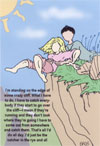
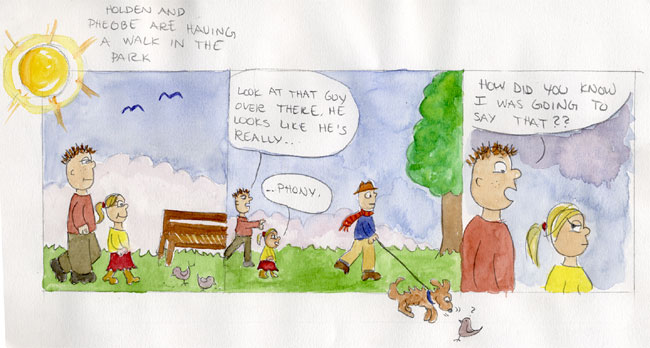
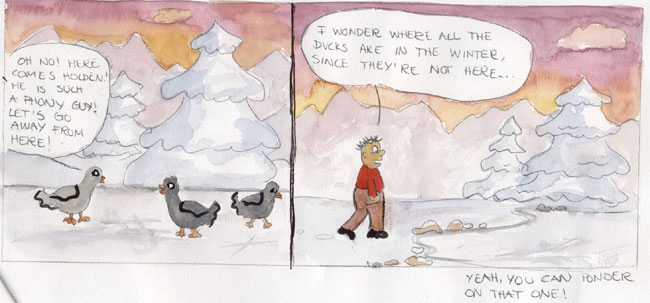
This is your time to get creative! We need a comic strip - or a nice, relevant picture for our page. You may choose to use: pictures from the Internet, the painter on Microsoft Word, clip art, print artist, art materials and paper or simply paint something yourself. Your comic strip should deal with a significant theme, event or symbol from the novel. For example, your topic could be: Allie’s mitt, ducks, checkers, phonies, the scene Mr. Antlioni or whatever you feel is an important idea from the novel.
(examples: painting + comic strips)
Relax--this might be the easiest of all your tasks. You are first going to find Robert Burns' poem, "Comin’ Thro the Rye" (see link below) and include it in this special section of the paper. Be sure to include the title and author the poem.
Secondly, find a picture (i.e. in a magazine, family photo album, on-line) that you think represents the poem and include it next to the poem on the page. Write a caption below the photo that explains in a sentence or two how the photo relates to the poem.
Thirdly, explain the story told in the poem, and how Holden Caulfield misunderstands it.
You will find useful information in the section called 'Symbols' HERE!
Task 6
This task is a simple and fun one. This special section of the paper needs an activity to engage the readers of our newspaper. You are first going to generate ten clues and answers for a crossword puzzle. Next, go to Puzzle Maker 1 or Puzzle Maker 2 to enter your clues and create your puzzle. When your puzzle is complete, add it to your section, through either scanning or printing, then manually pasting it.
Task 7
You have found a list of quotations from the novel on the net.
Make your own consentrated summaries of these with explanations included.
Task 8
Skim through this page, called 'Themes, Motifs and Symbols', and underline everything you find relevant to your presentation.
Write brief comments to the information you have underlined.
Finish this section by discussing the theme of the novel and its relevance to young people of today.
Evaluation
Articles should be typed and the material should be presented as a section (although it does not have to be multiple pages) of a newspaper. The assignment should be: free of grammatical errors, interesting, organized, creative and well worded. It should show a level of deep thought and should be in the specified formats (synopsis, business letter, editorial, etc.). Your work should display facts and opinions when necessary. Show the readers of the newspaper that you have read, re-read, reflected and now understand the novel through these tasks.
It goes without saying that all communication with your partner and other students/teachers, oral as well as written, should be in English!!!
oppdatert 26.02.2018
Page visited
21495 times
Totalt:



 = Compulsory